Understand it in 60 seconds · Components
The inductor
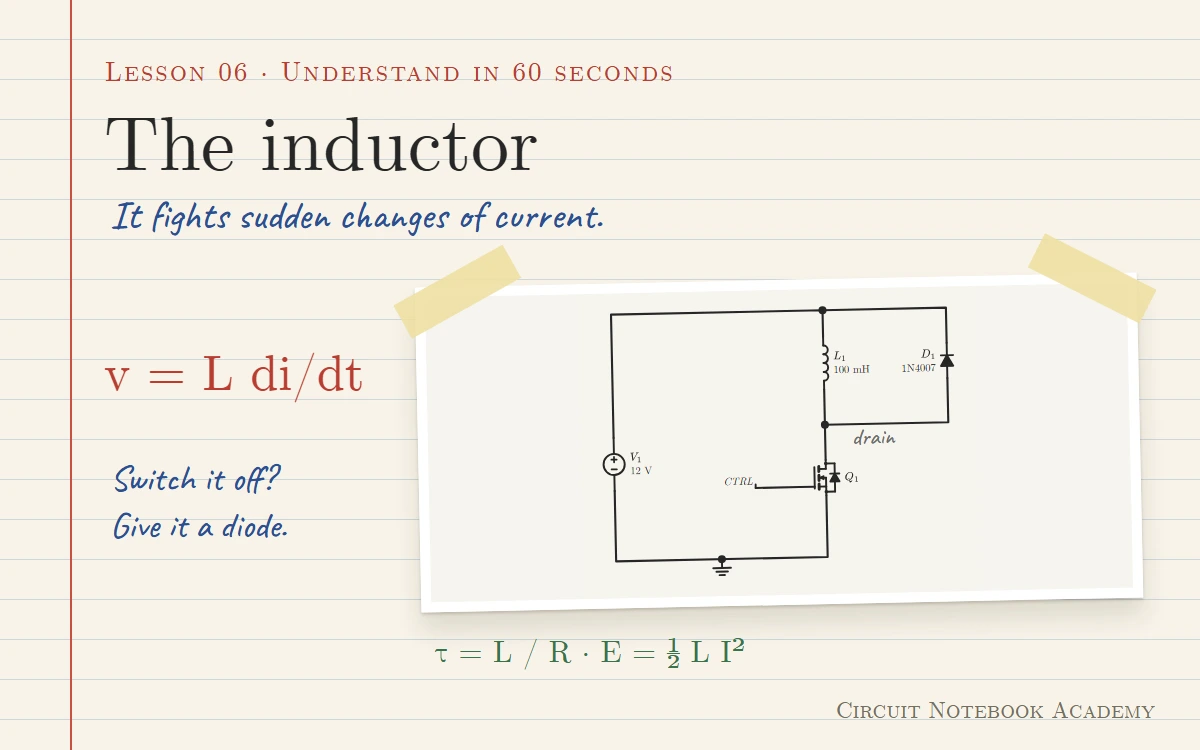
Why does a transistor die switching off a coil? Water turning a heavy wheel: it resists, then keeps pushing — slam the valve and the pipe bursts. v = L di/dt, τ = L/R, the flyback diode that saves the day, and the boost converter that puts the kick to work.
Beginner · published 14 October 2026
Free · no account needed · it opens in your browser
What you will understand
- Water turning a heavy wheel: it resists when the flow starts, then keeps pushing. The wheel is the coil; its spin, the magnetic field.
- A current makes a magnetic field, and the field stores the energy. L, the inductance, is in henries (H).
- It fights any sudden change of current: v = L di/dt. With a resistor, τ = L/R: 63 % after τ, about 99 % after 5τ.
- Cut the current fast and L di/dt becomes huge (500 V when cut in 100 µs): that is what kills the transistor.
- A flyback diode across the coil (cathode on +V) lets the current fade out gently; the boost converter puts the kick to work.
Inside the lesson
The cheat sheet
Every equation on one page, with the circuit drawn. Export it to PDF to keep it.
The animated presentation
The idea step by step, with the currents flowing in the circuit. Press Present (F5) to play it.
Your own copy
It opens as a Circuit Notebook project: change the values, reuse the circuit in your report.
Read next
-
Power electronics
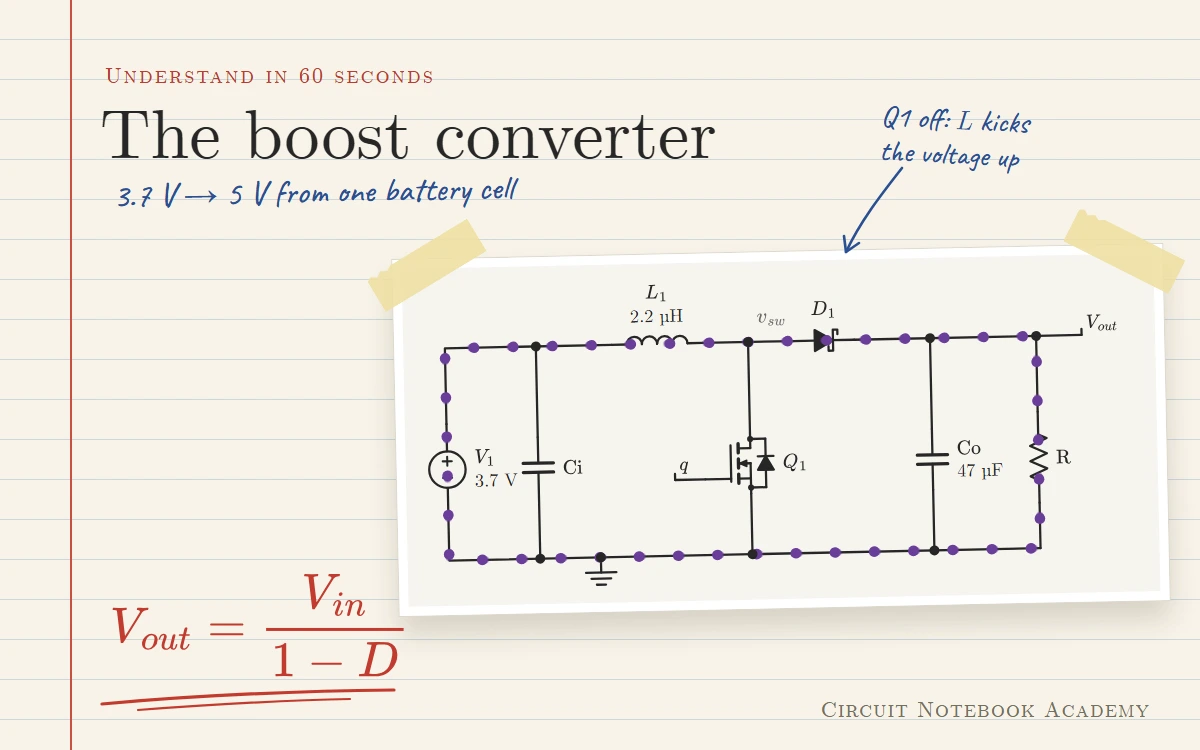
The boost converter
The boost converter in 60 seconds: how a power bank lifts a 3.7 V battery to 5 V with an inductor, a switch and a diode, and why Vout = Vin / (1 − D).
-
Components
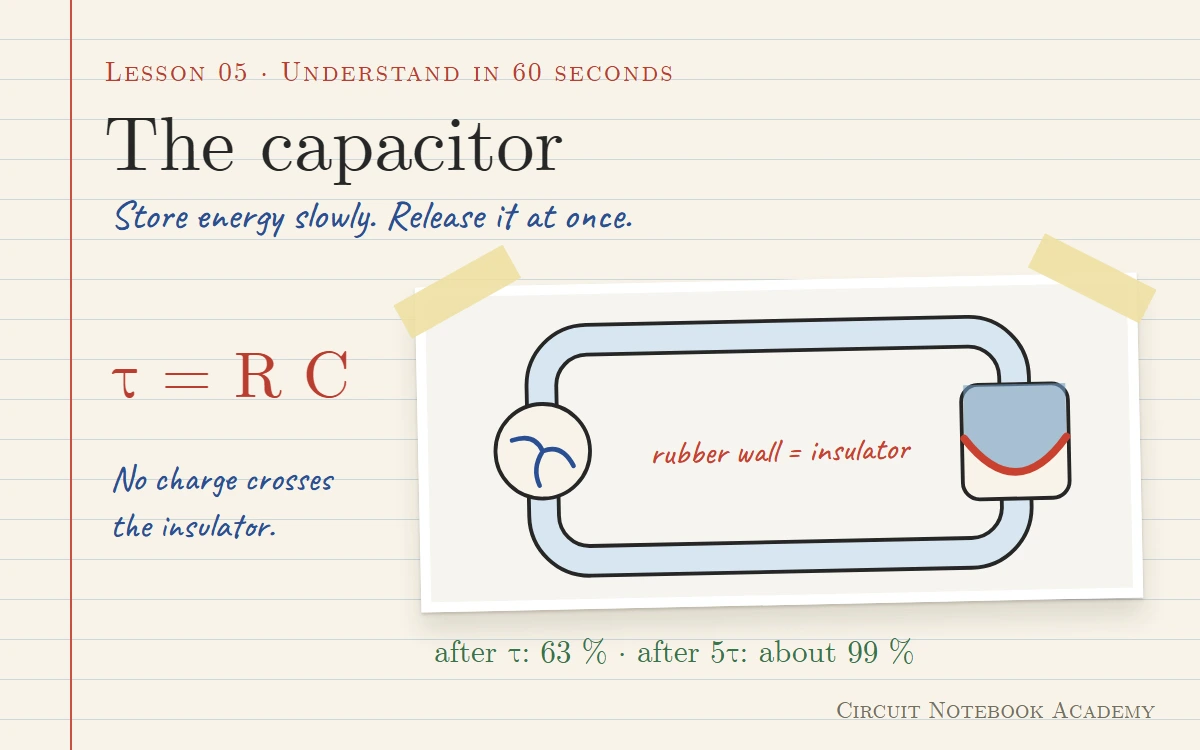
The capacitor
The capacitor in 60 seconds: two plates and an insulator, Q = CV, the RC time constant, and how a camera flash stores energy slowly and releases it at once.