Understand it in 60 seconds · Components
The capacitor
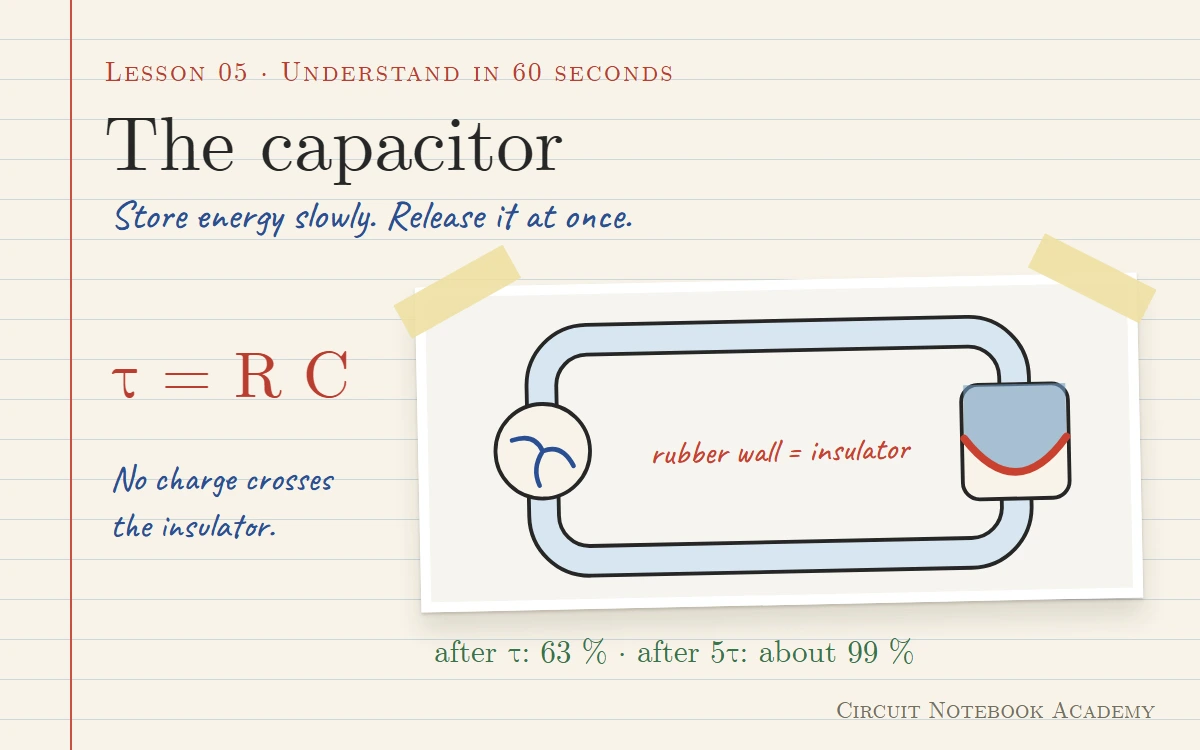
How does a camera flash store a burst of light? A pipe blocked by a stretchy rubber wall: no water gets through, yet the wall pushes back. Two plates, an insulator, and τ = RC: store energy slowly, release it at once.
Beginner · published 11 October 2026
Free · no account needed · it opens in your browser
What you will understand
- A pipe blocked by a stretchy rubber wall: no water gets through, yet the wall pushes back. The pump is the battery; the wall, the insulator.
- Two metal plates and an insulator: charge piles up, +Q on one, −Q on the other. Q = CV, with C in farads (F).
- Charged through a resistor: fast, then slower and slower. τ = RC: 63 % after τ, about 99 % after 5τ.
- It stores E = ½ CV2: a camera flash charges it slowly, then empties it into the lamp at once.
- Real capacitors slowly leak: watch the voltage rating and the polarity of electrolytic capacitors.
Inside the lesson
The cheat sheet
Every equation on one page, with the circuit drawn. Export it to PDF to keep it.
The animated presentation
The idea step by step, with the currents flowing in the circuit. Press Present (F5) to play it.
Your own copy
It opens as a Circuit Notebook project: change the values, reuse the circuit in your report.
Read next
-
Components
The inductor
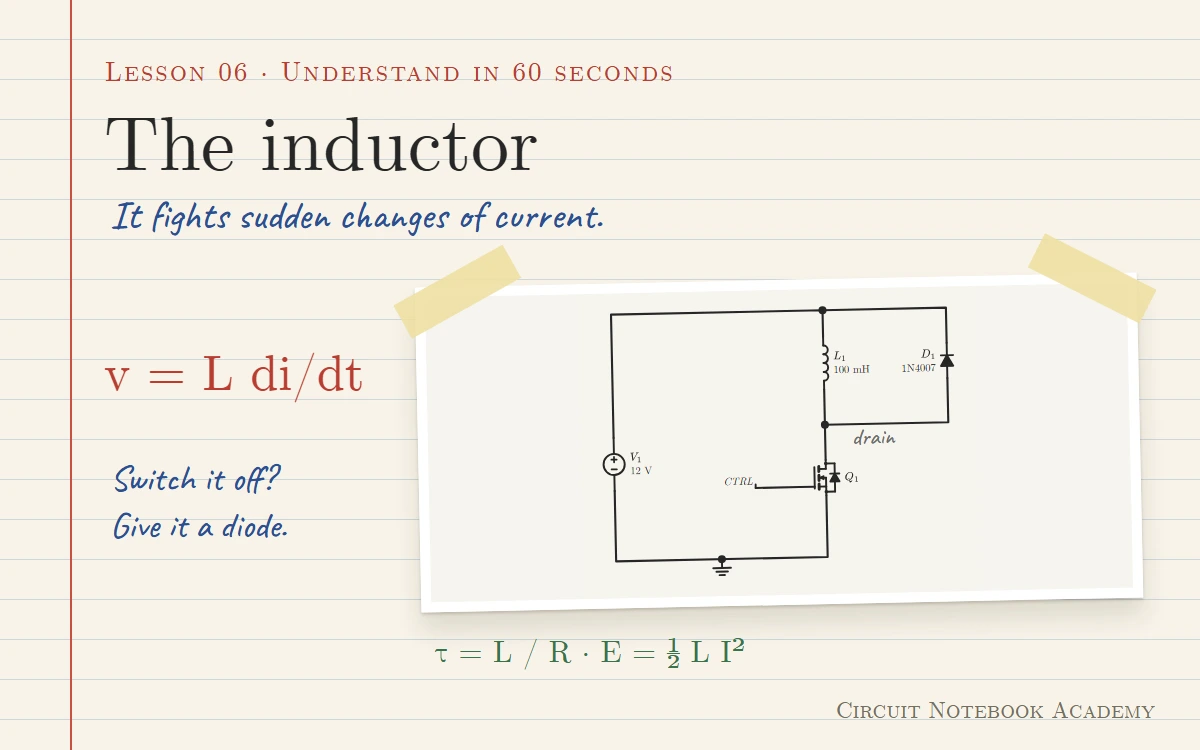
The inductor in 60 seconds: a heavy wheel that fights sudden changes of current, v = L di/dt, τ = L/R, and why a coil needs a flyback diode.
-
Components
The resistor
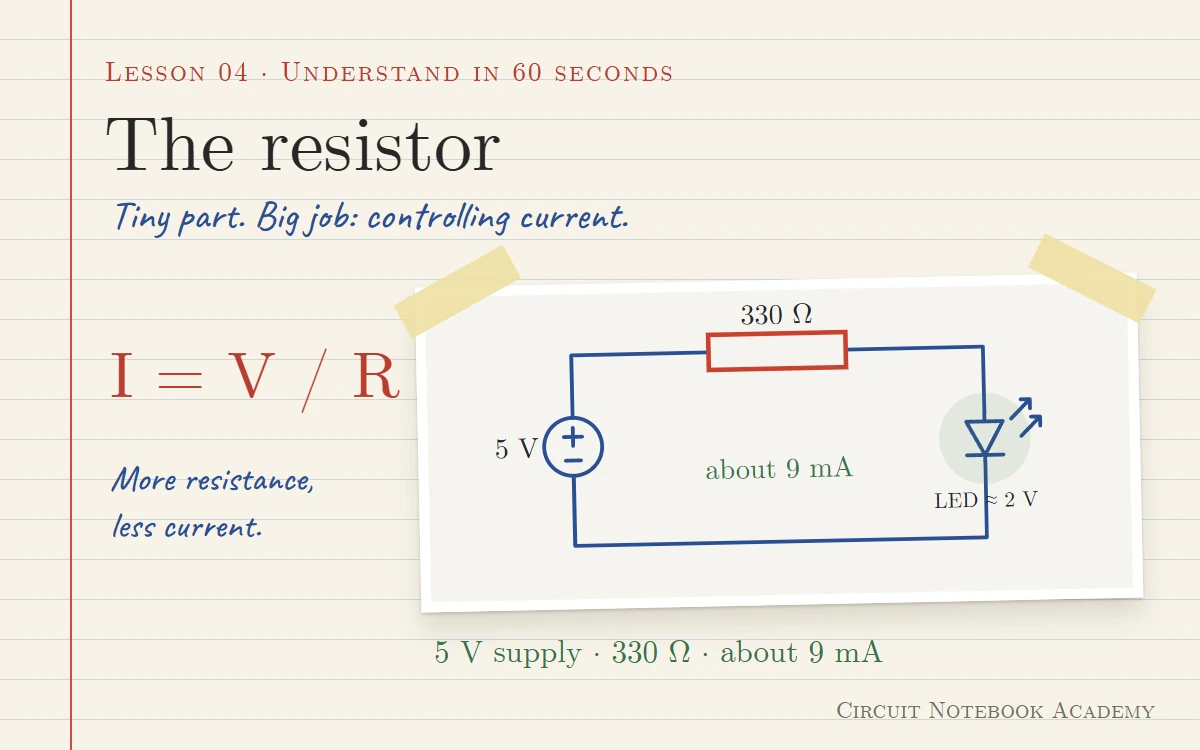
The resistor in 60 seconds: a water valve that limits current, Ohm’s law, how to protect an LED, and where the energy goes (heat and power rating).