Understand it in 60 seconds · Power electronics
The boost converter
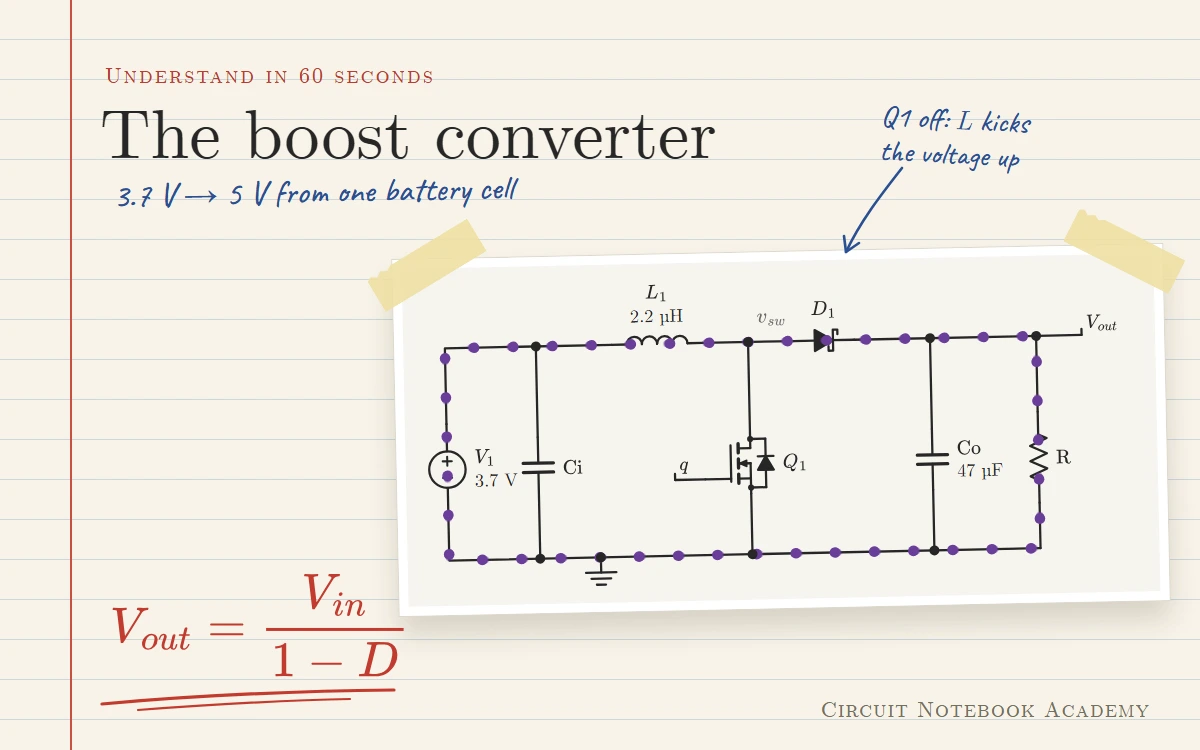
How a power bank gets 5 V out of a 3.7 V battery: an inductor kicks back when its current is cut, and the output becomes the input divided by (1 − D).
Intermediate · published 2 October 2026
Free · no account needed · it opens in your browser
What you will understand
- A resistor or a buck converter can only lower a voltage: to go above the battery, stack a kick on top of it.
- Q1 on: the battery charges the inductor. Q1 off: battery and inductor in series push through the diode, above Vin.
- Ideally Vout = Vin / (1 − D); with the diode drop, D ≈ 0.31 for 3.7 V → 5 V.
- The price: the battery gives Iin = Iout / (1 − D), about 2.9 A for 2 A out.
- No short-circuit protection: the input, the inductor and the diode always conduct, even with Q1 off.
Inside the lesson
The cheat sheet
Every equation on one page, with the circuit drawn. Export it to PDF to keep it.
The animated presentation
The idea step by step, with the currents flowing in the circuit. Press Present (F5) to play it.
Your own copy
It opens as a Circuit Notebook project: change the values, reuse the circuit in your report.
Read next
-
Power electronics
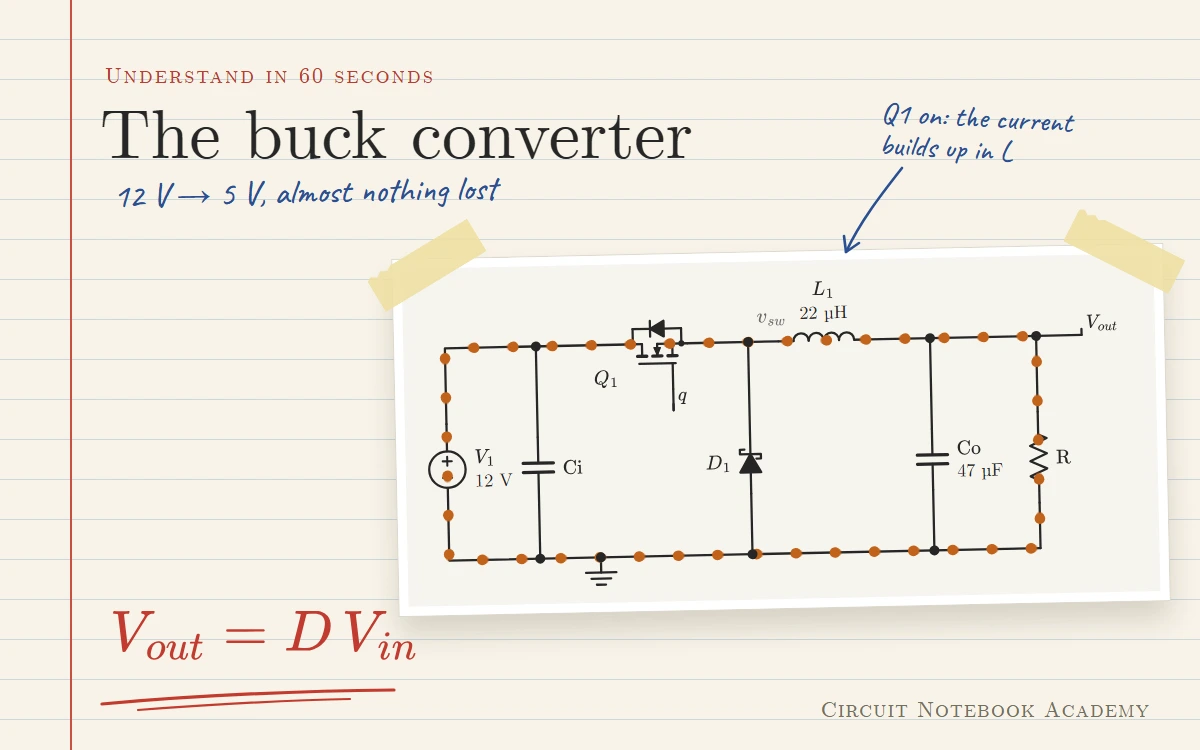
The buck converter
The buck converter in 60 seconds: how a switch, a diode, an inductor and a capacitor step 12 V down to 5 V with almost no loss, and why Vout = D × Vin.
-
Components
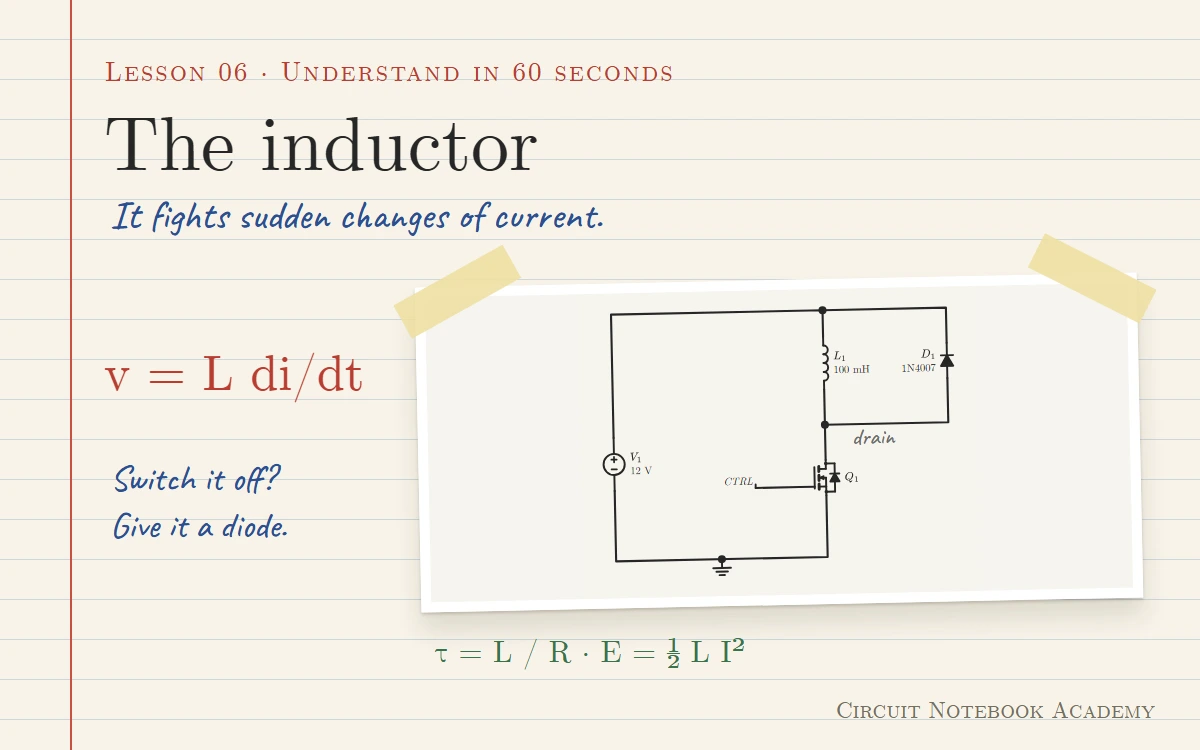
The inductor
The inductor in 60 seconds: a heavy wheel that fights sudden changes of current, v = L di/dt, τ = L/R, and why a coil needs a flyback diode.