Build it · Analog
The night pumpkin
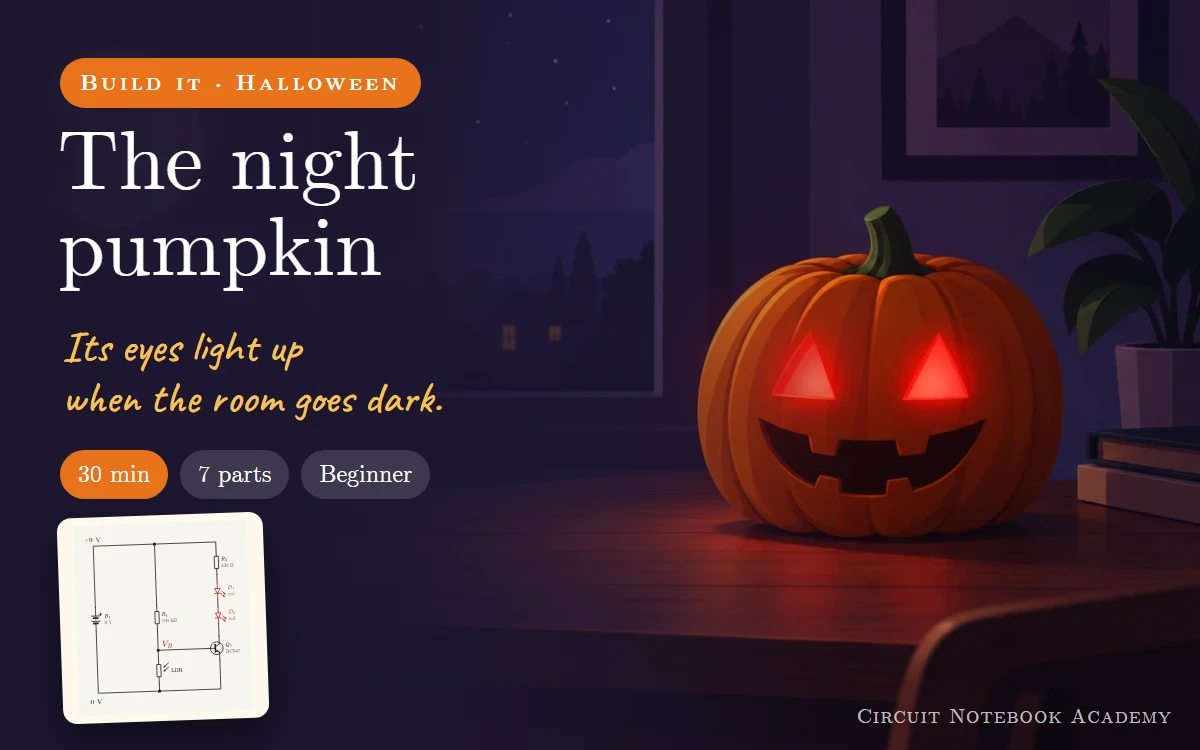
A Halloween pumpkin whose eyes light up by themselves when the room goes dark: a light sensor and a resistor make a voltage divider, a transistor switches two red LEDs on. A build sheet to print, and how it works in eight animated slides.
Beginner · 30 min · 7 parts · published 24 October 2026
Free · no account needed · it opens in your browser
What you learn by building it
- A light sensor (LDR): its resistance rises in the dark.
- With a 100 kΩ resistor it makes a voltage divider that follows the light: lit, VB ≈ 0.4 V; in the dark it climbs to 0.7 V.
- A BC547 transistor used as a switch: a tiny base current turns the 15 mA of the two red LEDs on.
- LEDs in series and the 330 Ω resistor that protects them; a 9 V battery keeps the eyes glowing about 30 hours.
- If it does not work: turn the LEDs round (long leg to +) and check C, B, E. A 100 kΩ trimmer sets how dark it must be.
What you need
- 9 V battery + clip
- Light sensor (LDR)
- 100 kΩ resistor
- BC547 NPN transistor
- 330 Ω resistor
- 2 × red LED, 5 mm
- Breadboard + wires
Inside the project
The build sheet
The parts, the schematic, the steps and what to check, on one page to print.
How it works
The physics step by step, in animated slides. Press Present (F5) to play them.
Your own copy
It opens as a Circuit Notebook project: change the values, draw your own version.
Read next
-
Analog
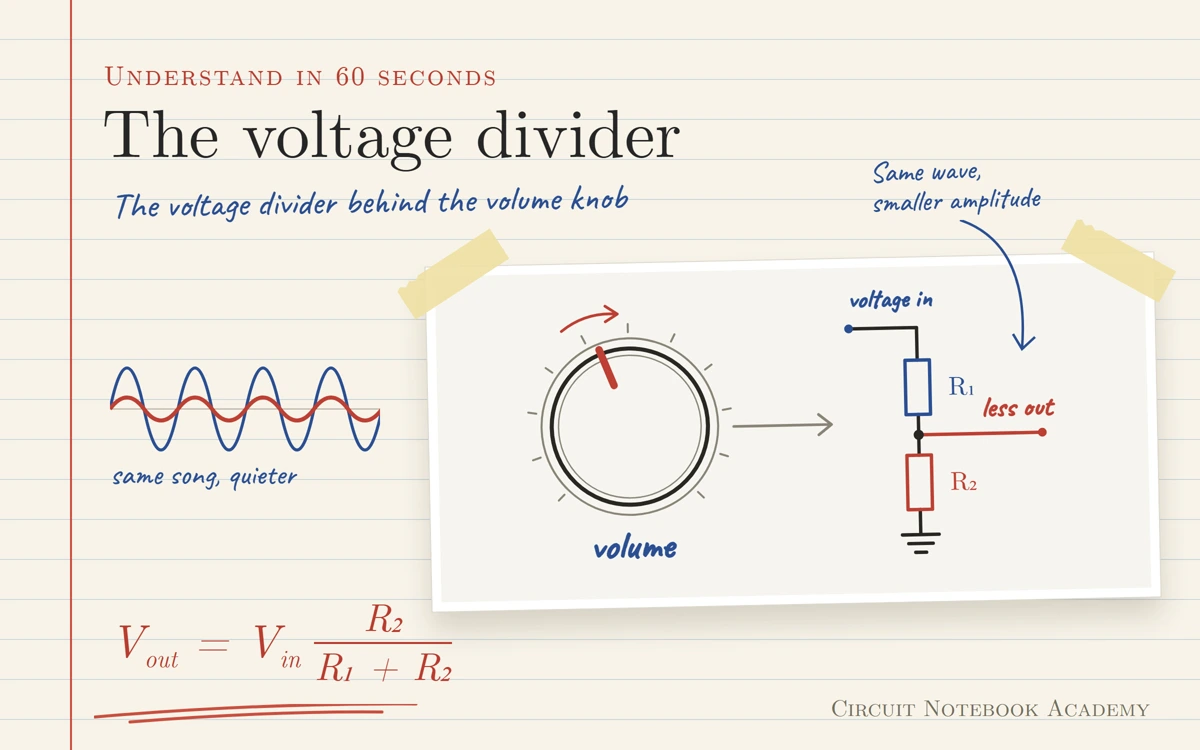
The voltage divider
The voltage divider in 60 seconds: two resistors share the voltage, Vout = Vin·R2/(R1+R2), and a potentiometer turns a song down before the amplifier.
-
Components
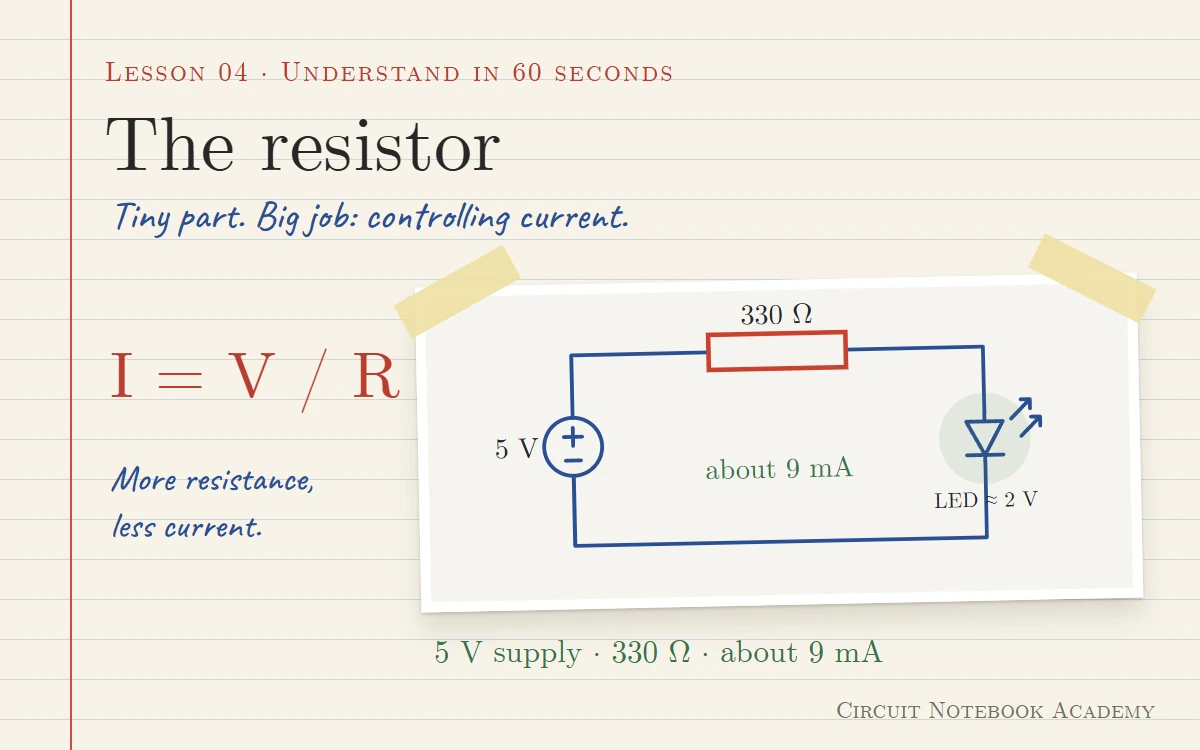
The resistor
The resistor in 60 seconds: a water valve that limits current, Ohm’s law, how to protect an LED, and where the energy goes (heat and power rating).